










- Significantly more powerful for complex calculations and data manipulation
- Native automations reduce dependence on tools like Zapier
- Better suited for teams building internal tools and operational dashboards
- Generally handles larger datasets more efficiently than Notion
- Advanced formulas and cross-table logic far more powerful than Notion's formula system
- Native automations and "Packs" with built-in integrations to Slack, Gmail, and Jira without external services
- Doc-maker pricing model where only doc creators pay (viewers and editors can be free depending on plan)
- Better suited for data-heavy workflows and complex calculations
Coda
Pricing

- Combines project management, documentation, time tracking, and communication
- Highly customizable workflows
- Free plan provides robust functionality for small teams
- Advanced automation capabilities
- Enterprise-grade features at competitive pricing
- Steep learning curve requires significant onboarding time
- Performance issues including slow load times and occasional lag reported
- Limited native integrations compared to some competitors
- Mobile app limitations compared to the desktop experience
- Interface complexity may feel cluttered
ClickUp
Pricing
- Designed specifically for remote and distributed team needs
- Simple, clean interface encourages regular use and contribution
- Good balance of features without overwhelming complexity
- Effective search and organization capabilities
- Reasonable pricing for small to medium-sized teams
- Limited project management capabilities compared to all-in-one platforms
- Basic code formatting and technical documentation features
- Restricted customization options due to opinionated design philosophy
- Copy/paste functionality can be inconsistent
- Limited offline capabilities and mobile experience
Slite
Pricing

- Deep integration eliminates data silos for Microsoft-centric organizations
- Leverages existing Microsoft 365 security and compliance frameworks
- Familiar user experience for teams already using Microsoft tools
- Real-time synchronization across the entire Microsoft productivity suite
- Native Microsoft 365 integration with components that sync seamlessly across Teams, Outlook, Word, and other Office apps
- Enterprise security and compliance inherited from existing Microsoft 365 governance policies
- Live components across apps that appear and update in real-time across multiple Microsoft applications
- Familiar Microsoft interface consistent with other Microsoft tools, reducing training needs
Microsoft Loop
Pricing

- Full control over data with no cloud dependencies required
- Highly customizable through plugins and themes
- Strong for building interconnected knowledge over time
- Works completely offline when needed
- Local-first architecture with files stored on your device and optional cloud sync for collaboration
- Powerful graph visualization showing visual representation of knowledge connections
- Extensive plugin ecosystem with hundreds of community plugins for specialized functionality
- Complete data ownership with files in standard Markdown format, avoiding vendor lock-in
Obsidian
Pricing
Notion has become a popular all-in-one workspace combining notes, databases, tasks, and wiki functionality. But many teams seek alternatives due to performance bottlenecks with large databases, steep learning curves for non-technical users, limited project management depth, or pricing concerns as AI features get bundled into higher tiers.
Whether you're hitting Notion's scaling limits or need something more specialized for your workflow, several strong alternatives offer different approaches.
Here's what to consider when evaluating your options.
Top Alternatives to Notion
These five platforms offer distinct advantages depending on your priorities and use case.
Alternative #1—Coda
Coda positions itself as the closest all-around Notion replacement, but with significantly more powerful formulas, automation, and database capabilities. It follows a "docs-as-apps" philosophy where documents can contain interactive tables, buttons, and complex logic.
Teams choose Coda when they need Notion's flexibility but hit limitations with performance, automation, or data manipulation.
What Does Coda Do
Coda creates interactive documents that combine rich text, database-like tables, and spreadsheet-style formulas with automation capabilities. Teams use it for product roadmaps, OKR tracking, CRM systems, and project dashboards built within documents that can be shared and collaborated on.
Coda Differentiators
- Advanced formulas and cross-table logic far more powerful than Notion's formula system
- Native automations and "Packs" with built-in integrations to Slack, Gmail, and Jira without external services
- Doc-maker pricing model where only doc creators pay (viewers and editors can be free depending on plan)
- Better suited for data-heavy workflows and complex calculations
Coda Pros
- Significantly more powerful for complex calculations and data manipulation
- Native automations reduce dependence on tools like Zapier
- Better suited for teams building internal tools and operational dashboards
- Generally handles larger datasets more efficiently than Notion
Coda Pricing
- Free: Personal use with document size and feature limitations
- Pro: $10/doc maker/month (billed annually) for small teams
- Team: $30/doc maker/month (billed annually) with advanced features
- Enterprise: Custom pricing with enhanced security and admin controls
Alternative #2—ClickUp
ClickUp markets itself as "one app to replace them all," offering project management, docs, goals, whiteboards, and collaboration features as core capabilities. Teams choose ClickUp when they need stronger project management than Notion provides, particularly for complex workflows with dependencies and time tracking.
The platform is project-first, with documentation as a supporting feature rather than the other way around.
What Does ClickUp Do
ClickUp provides comprehensive project and work management with tasks, docs, goals, dashboards, and team collaboration features. It emphasizes visual project tracking through multiple views (lists, boards, Gantt, calendar) while incorporating document collaboration.
ClickUp Differentiators
- Project management-first approach with built-in sprints, dependencies, workload views, and time tracking
- Multiple project views including native Gantt charts, Kanban boards, and calendar views
- Resource management with team capacity planning and workload distribution tools
- Strong automation capabilities with built-in workflow automation for project processes
ClickUp Pros
- Superior project management features compared to Notion's basic task capabilities
- Better suited for teams running complex, interdependent projects
- Strong reporting and analytics for project performance
- Comprehensive all-in-one approach reduces tool switching
How ClickUp Works with Siit
ClickUp integrates with Siit to automate ticket creation and match records between platforms. When employees submit requests through Slack or Teams, Siit can automatically create corresponding ClickUp tasks with full context.
Internal support teams manage requests in Siit's unified dashboard while project work stays organized in ClickUp. AI-powered workflows handle cross-departmental coordination that ClickUp wasn't designed for.
ClickUp Pricing
- Free Forever: Feature-rich free plan with unlimited tasks and core project management
- Unlimited: $7/user/month (billed annually) with expanded storage and features
- Business: $12/user/month with advanced features and integrations
- Enterprise: $19/user/month with enhanced security and controls
Alternative #3—Slite
Slite focuses specifically on team knowledge management and documentation, positioning itself as a more structured and AI-enhanced alternative to Notion's wiki functionality. Teams choose Slite when they want dedicated knowledge management without the complexity and potential sprawl of Notion's flexible workspace model.
It's opinionated about structure, which prevents the chaos that can emerge in flexible tools.
What Does Slite Do
Slite creates organized team knowledge bases with built-in AI search, document verification, and structured information architecture. It emphasizes keeping team knowledge current, discoverable, and trustworthy through automated maintenance suggestions.
Slite Differentiators
- AI-powered knowledge management with natural language search and answers from verified documents
- Opinionated structure with built-in organization that prevents sprawl common in flexible tools
- Document verification workflows to keep knowledge current and accurate
- Simplified interface with lower learning curve compared to Notion's database complexity
Slite Pros
- Focuses specifically on knowledge management rather than trying to be everything
- AI features designed specifically for team documentation and Q&A
- Easier adoption for non-technical team members
- Better governance for maintaining accurate, up-to-date information
Slite Pricing
- Free: Limited team size and features
- Standard: $8/user/month for full team features
- Premium: $12.50/user/month with advanced AI and analytics
- Enterprise: Custom pricing with enhanced security and compliance
Alternative #4—Microsoft Loop
Microsoft Loop provides collaborative workspaces with live components that sync across Microsoft 365 applications. Teams in Microsoft-centric organizations choose Loop when they want Notion-like functionality while staying within their existing Microsoft ecosystem and security framework.
It's not a standalone product; Loop is part of Microsoft 365 subscriptions.
What Does Microsoft Loop Do
Loop creates collaborative workspaces with reusable components (tasks, tables, notes) that stay synchronized wherever they're embedded across Microsoft 365 apps like Teams, Outlook, and Word. It enables real-time collaboration on shared content.
Microsoft Loop Differentiators
- Native Microsoft 365 integration with components that sync seamlessly across Teams, Outlook, Word, and other Office apps
- Enterprise security and compliance inherited from existing Microsoft 365 governance policies
- Live components across apps that appear and update in real-time across multiple Microsoft applications
- Familiar Microsoft interface consistent with other Microsoft tools, reducing training needs
Microsoft Loop Pros
- Deep integration eliminates data silos for Microsoft-centric organizations
- Leverages existing Microsoft 365 security and compliance frameworks
- Familiar user experience for teams already using Microsoft tools
- Real-time synchronization across the entire Microsoft productivity suite
Microsoft Loop Pricing
- Included in Microsoft 365 Business subscriptions ($6-22/user/month)
- No standalone Loop options available; only accessible as part of qualifying Microsoft 365 subscriptions
- Enterprise features scale with existing Microsoft 365 enterprise plans
Alternative #5—Obsidian
Obsidian offers a local-first approach to knowledge management with powerful linking, graph visualization, and plugin extensibility. Teams and individuals choose Obsidian when they want complete control over their data, offline capability, and highly customizable knowledge management without cloud dependencies.
It's fundamentally different from cloud-first tools: your files live on your device in standard Markdown format.
What Does Obsidian Do
Obsidian creates networked knowledge bases using Markdown files stored locally on your device, with powerful bidirectional linking, graph visualization, and extensive customization through community plugins. It focuses on connection discovery and long-term knowledge building.
Obsidian Differentiators
- Local-first architecture with files stored on your device and optional cloud sync for collaboration
- Powerful graph visualization showing visual representation of knowledge connections
- Extensive plugin ecosystem with hundreds of community plugins for specialized functionality
- Complete data ownership with files in standard Markdown format, avoiding vendor lock-in
Obsidian Pros
- Full control over data with no cloud dependencies required
- Highly customizable through plugins and themes
- Strong for building interconnected knowledge over time
- Works completely offline when needed
Obsidian Pricing
- Free: Full desktop functionality for personal, commercial, and non-profit use
- Catalyst: $25 one-time for early access to new features
- Sync: $8/month for official cloud synchronization service
- Publish: $16/month for web publishing capabilities
How Siit Connects Your Project Management Tools
These workspace platforms handle documentation, projects, and team collaboration. But the operational workflows that span IT, HR, Finance, and Operations typically require manual coordination across separate systems.
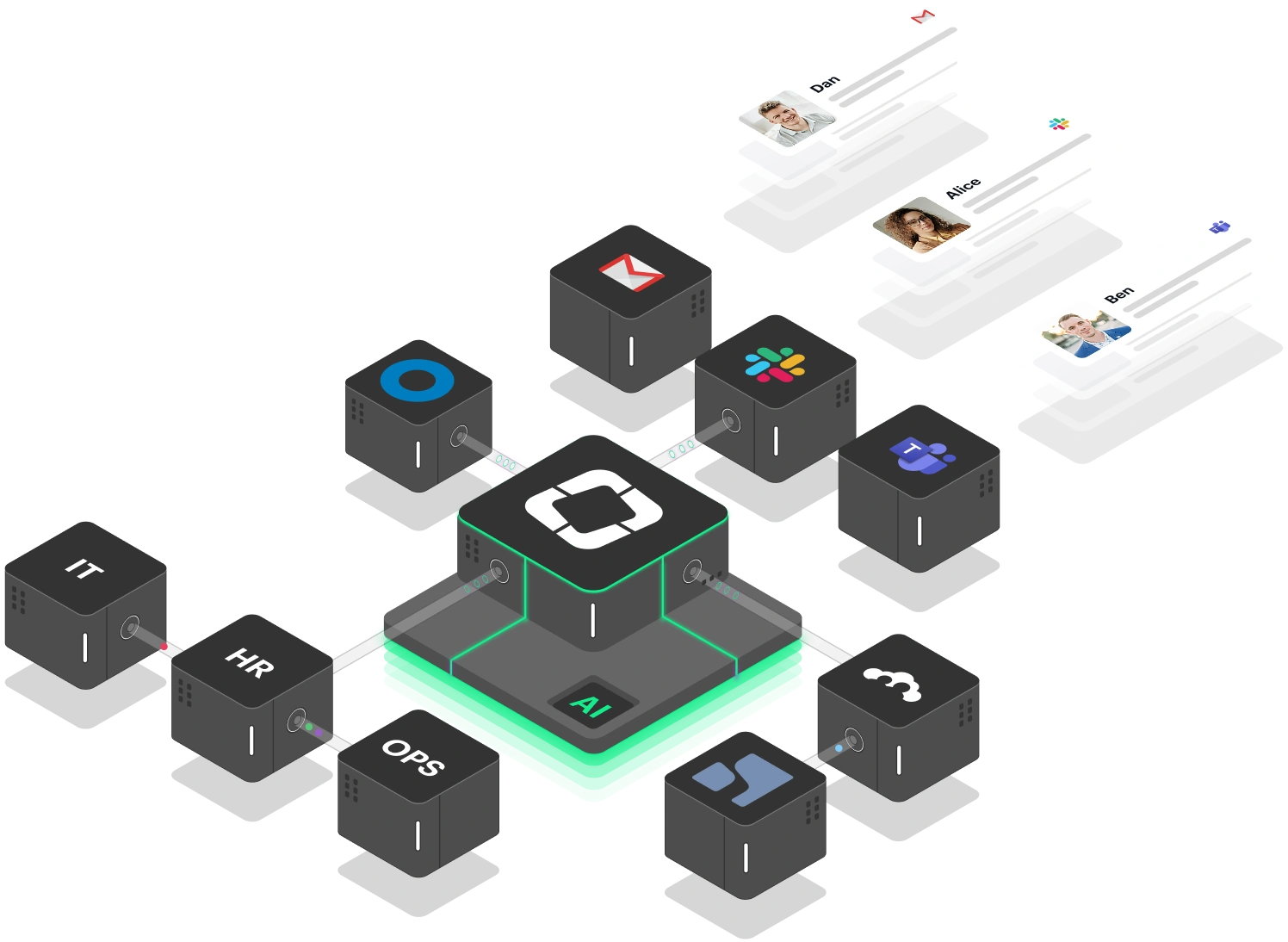
Siit integrates with knowledge bases like Notion and Confluence, project tools like ClickUp and Asana, and communication platforms like Slack and Teams. When employees ask questions, Siit's AI assistant can search your knowledge base and suggest relevant pages automatically.
With 50+ native integrations, Siit creates a unified operational layer that makes your workspace tools work better together. Your choice of documentation platform becomes less critical when AI-powered workflows handle the coordination between systems and departments.