Why companies switch from Ivanti to Siit
Your AI already knows the employee. No CMDB required.
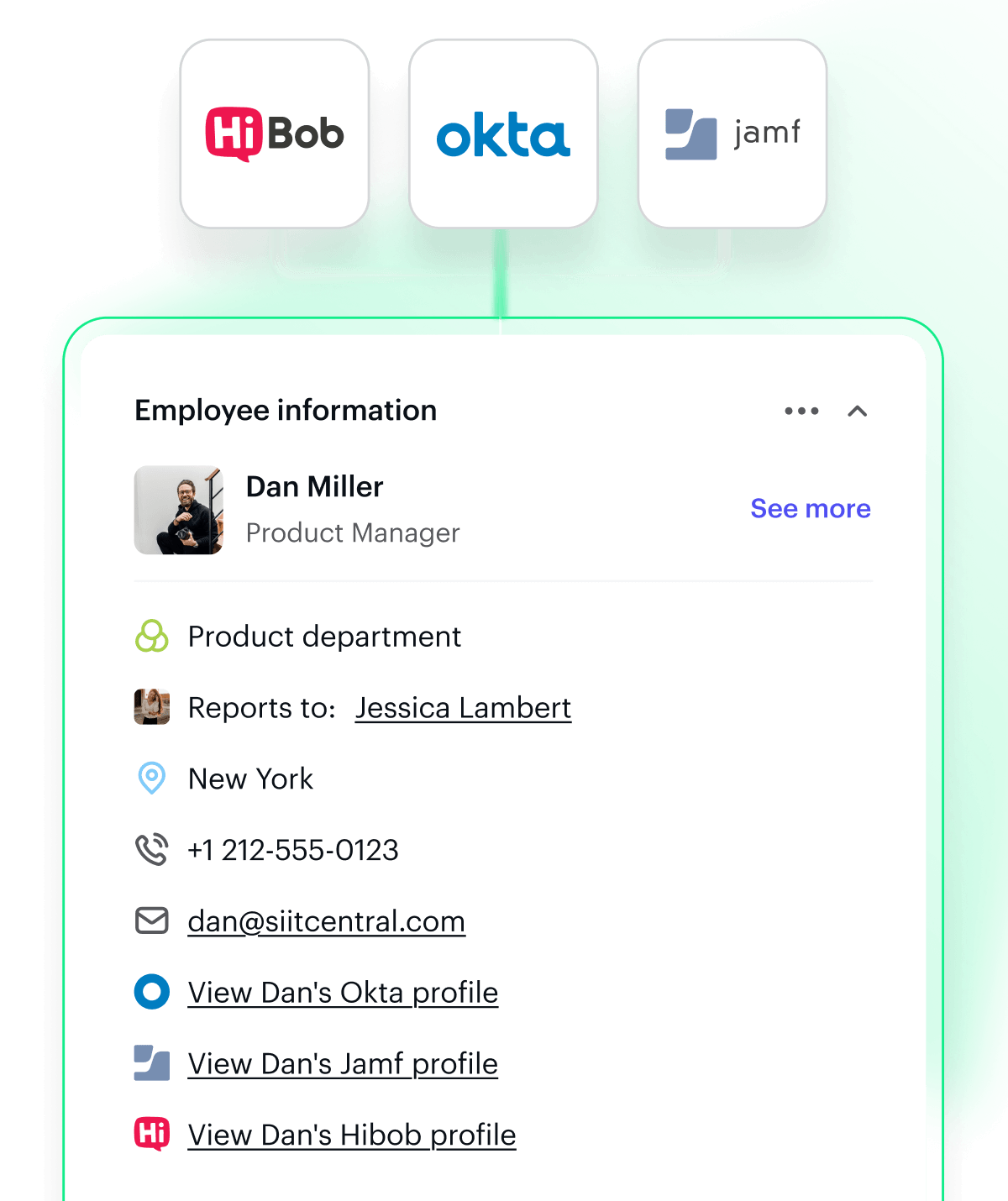
Siit syncs live context from your HRIS, IdP, and MDM into a single persistent employee profile. When a request arrives, the AI already knows who's asking, what they're entitled to, and how to resolve it. No CMDB required.
Ivanti for ITSM is portal-first and ITIL-governed, with context built on Active Directory and asset records. Employee identity data (role, manager, entitlements, SaaS access) must be assembled at resolution time through integrations or manual configuration.


AI that closes the ticket. Not just follows the workflow.
Siit's AI is in production today. It evaluates policy, routes approvals in Slack or Teams, provisions in Okta or Jamf, and confirms back in thread. End-to-end, without agent intervention.
Ivanti's agentic AI launched in customer preview in Q1 2026, with general availability later in 2026. Today's broadly deployed capability is ITIL-governed workflow automation: rules-based routing, ticket prioritization, and a self-service portal. Execution still requires agents for cross-system provisioning.

Built for where your employees actually work.
Siit is chat-native. Request, approval, provisioning, confirmation: start to finish in Slack or Teams, with zero portal redirect.
Ivanti for ITSM (Neurons) is portal-first: the self-service portal is the primary interface for employees. Teams requires a manually configured bot; Slack isn't natively supported. Complex workflows are completed in the portal, not in chat.
See what happens when your service desk actually delivers.


Siit helped deflect 28% of support tickets that otherwise would have been handled by IT.

Siit gives teams autonomy to manage their own requests and business processes without IT help.

Siit has improved our efficiency and cost-effectiveness on our internal help desk and helped us better support our employees.
Trusted by the best






FAQs
What is the difference between Siit and Ivanti Neurons?

Ivanti Neurons is built around endpoint management and ITIL-governed workflows; powerful for IT asset tracking and structured service delivery. Siit is built around your employees: persistent profiles synced live from your HRIS, IdP, and MDM, so the AI resolves requests end-to-end without agent intervention.
Can Siit replace Ivanti Neurons for internal IT operations?
Yes. Migration focuses on connecting your identity and HR systems, not rebuilding ITIL schemas or endpoint management configurations. Most teams are live within weeks.
Does Siit work inside Slack and Teams?
Yes. Dynamic forms, multi-stage approvals, and AI execution happen entirely within Slack or Microsoft Teams. No portal redirect, no new login required; even for complex multi-party approval workflows.
How does Siit's AI compare to Ivanti's agentic AI?
Ivanti's agentic AI launched in customer preview in Q1 2026, with general availability later in 2026. Siit's AI agents are in production today. That leads to provisioning access in Okta, triggering onboarding in Workday, resetting passwords; lend-to-end, without agent intervention.
How fast can teams go live with Siit after leaving Ivanti?
Most teams are live within weeks. Because Siit is integration-driven, migration focuses on connecting your HRIS and identity systems, not rebuilding ITIL process schemas or CMDB configurations.