Siit vs. Servicenow

ServiceNow manages requests through a portal built on top of the CMDB. Siit already knows your employees and resolves requests end-to-end in Slack or Teams.

Book a demo

Why companies switch from
Servicenow to Siit

AI that already knows the employee. No CMDB to maintain.

Siit reads your sources of truth — HRIS, IdP, MDM — and keeps live employee profiles as its own system of record. When a request arrives, the AI already knows the requester's role, manager, devices, and entitlements.

Whether deployed standalone or as a fast conversational front-door to an anchored ServiceNow setup, with Siit there is no schema to model and no CSDM domains to maintain.

ServiceNow's intelligence lives in the CMDB, a model of your services and assets your team has to build and keep current. Now Assist is only as good as that configuration; where the data is incomplete, the AI falls back to routing errors and manual work.
Compare features
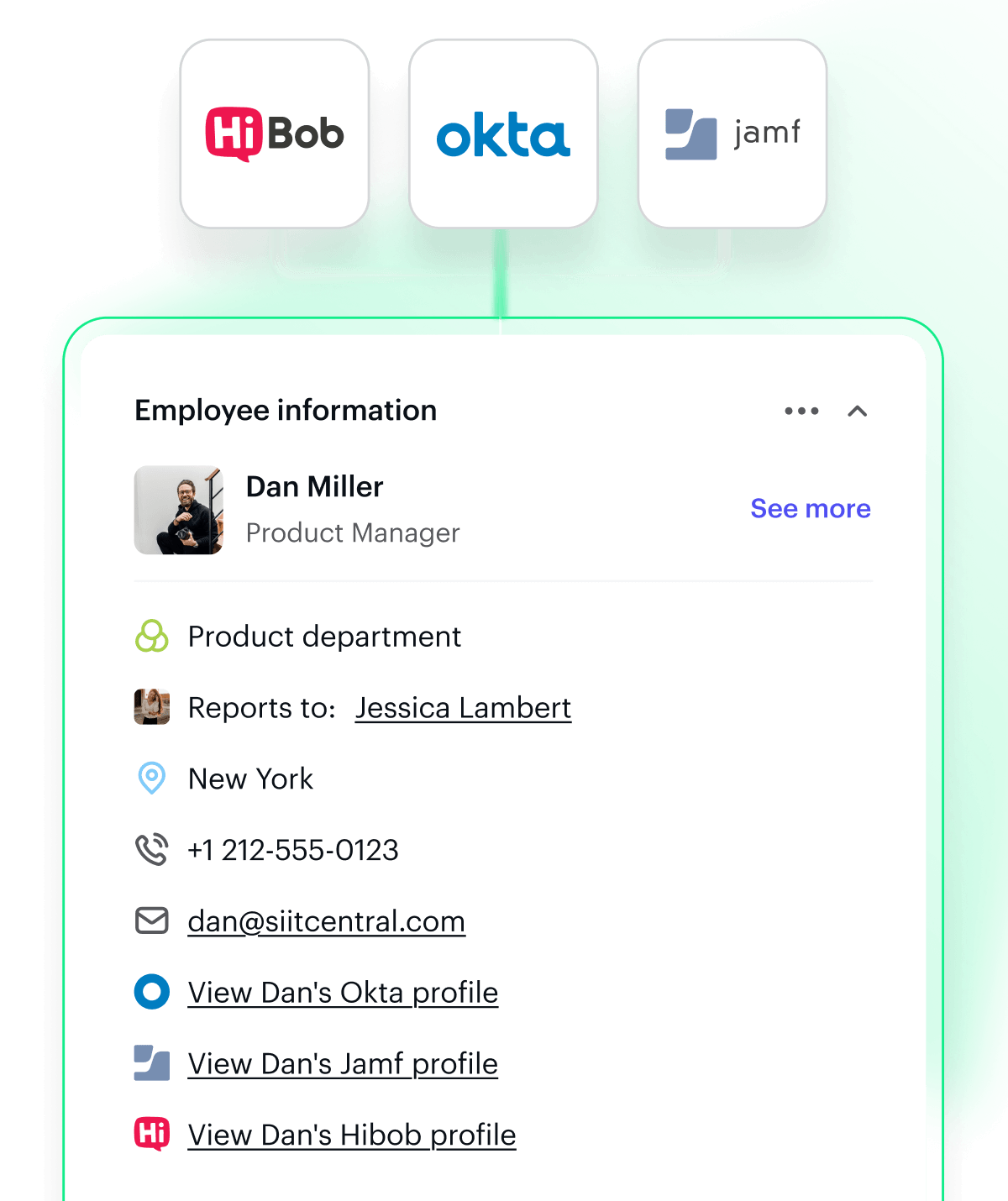
Employee info for Dan Miller, product manager in New York, with contact and profile links for Okta, Jamf, and Hibob.
Comparison
Features
Siit
ServiceNow
Data strategy
How employee context reaches the AI
Siit
Live employee profiles synced from HRIS, IdP, and MDM as the system of record. Context pre-built before the request arrives, with nothing to model or maintain.
Competitor
CMDB + CSDM as the system of record: deep and auditable, but the organization must model, govern, and maintain it. Workflow Data Fabric assumes high data maturity.
Employee context
What the AI sees at resolution time
Siit
Full profile (role, manager, devices, entitlements, applicable policy) assembled automatically and already there when the request arrives.
Competitor
CMDB/CSDM models services and assets; the platform's intelligence is bounded by how well that data is modeled and maintained, rather than built in before the request arrives.
AI quality
What the AI's accuracy depends on
Siit
Starts from a unified context that's already built, so routing accuracy improves over time with fewer hallucinations.
Competitor
Now Assist and predictive routing are bounded by the CMDB beneath them; incomplete or over-customized data degrades the AI into routing errors and manual fallbacks.
Integration depth
How the platform connects to your stack
Siit
Bidirectional: reads from and writes to HRIS, IdP, and MDM. Pulls context and executes provisioning without custom middleware.
Competitor
Broad integration network (Integration Hub spokes), but operational context must be modeled into the CMDB and kept current; SI-led configuration is common.

Consistency enforced by architecture. Not by a review board.

On Siit, workflows, policies, and approvals apply the same way on every request by default, so governance happens on the first touch, not in a review board. Standard admins configure flows visually; RBAC, audit logs, and SOC 2 / GDPR controls are built in; and with no custom code, upgrades ship without regression risk.

ServiceNow is so customizable that almost everything has to be reviewed. Larger deployments stand up governance committees and lean on certified admins and SIs to keep customizations coherent, and to stop technical debt breaking the bi-annual upgrades.
Compare features
Employee info for Dan Miller, product manager in New York, with contact and profile links for Okta, Jamf, and Hibob.
Comparison
Features
Siit
ServiceNow
Governance model
Where consistency and control come from
Siit
Enforced by architecture: RBAC, audit logs, and consistent workflows apply policy on every request by default.
Competitor
Achieved through governance boards, certified admins, and formal change processes that must be staffed and maintained.
Change agility
How fast a workflow change ships
Siit
Standard admins change a workflow visually in minutes, with no platform-specific scripting and no certified-developer dependency.
Competitor
Customizations reviewed by committee; changing a form can become a project, and custom scripts risk regression on bi-annual upgrades.
Scale
What it takes to grow across teams
Siit
Lean teams run the whole operation and scale across departments without adding headcount (~1:160 admin-to-employee at Monzo).
Competitor
Scaling typically requires more certified admins, SI partners, and governance overhead.
Compliance & audit
How policy and audit are enforced
Siit
RBAC, audit logs, and SOC 2 / GDPR controls built in; SaaS-native upgrades ship without regression risk.
Competitor
Deep, auditable governance and ITIL-grade change management, but staffed and maintained by a dedicated control function.

Go live tomorrow,

not next quarter.

No CMDB rebuild. No service catalog migration. Connect your tools, define scope, and you’re live. Most teams are fully operational in days - not months

Book a demo

Resolved in the conversation. Not redirected to the portal.

Siit is chat-native, not a chat layer over a portal. An employee asks in Slack → the AI checks policy against the pre-built profile → routes approval to the manager's DM → provisions in Okta or Jamf → confirms in thread. Forms, approvals, and knowledge all complete in Slack or Teams.

ServiceNow is built around the Employee Center portal, with the Virtual Agent as a doorway in front of it. The standard Virtual Agent ("Lite") strips NLU and blocks custom topics, and the richer features sit on the higher Employee Center Pro edition.

Compare features
Employee info for Dan Miller, product manager in New York, with contact and profile links for Okta, Jamf, and Hibob.
Comparison
Features
Siit
Servicenow
User interface
Where employees interact
Siit
Chat-native: all interactions, forms, approvals, and AI execution complete within Slack or Teams. No portal redirect.
Competitor
Portal-first: the Employee Center portal is the primary surface for substantive request interactions.
Conversational AI
What the chat experience can do
Siit
Full NLU and custom workflows in-thread, with no edition gating.
Competitor
Virtual Agent "Lite" strips NLU and blocks custom topic building; the richer experience requires the Employee Center Pro edition.
Approvals & forms
How approvals and forms are handled
Siit
Dynamic forms and multi-stage approvals run natively in-thread; managers approve in DM without leaving Slack.
Competitor
Substantive forms and approvals complete in the portal; chat primarily surfaces notifications and intake.
Employee adoption
How easily teams use the platform
Siit
Frictionless: meets employees where they already work, driving adoption without change management overhead.
Competitor
Adoption runs through the Employee Center portal; friction in Slack-first organizations.

See what happens when your service desk actually delivers.

cresta-log
airalo-logo
monzo-logo

Siit helped deflect 28% of support tickets that otherwise would have been handled by IT.

Ashley Brien
Tech Ops Support Lead at Monzo
25%
Requests automated
87%
SLA rate
160:1
Admin to employee ratio

Siit gives teams autonomy to manage their own requests and business processes without IT help.

Pauric Gallagher
Senior IT Operations Manager at Airalo
50%
Tickets automated
< 1 hr
Avg first response time
5x
Scale in employee headcount

Siit has improved our efficiency and cost-effectiveness on our internal help desk and helped us better support our employees.

Jared Allenbrand
Head of IT at Cresta
30%
Tickets automated
< 1 hr
Avg first response time
3x
Scale in employee headcount

See how Siit connects to your stack

Connect your existing tools. Go live without rebuilding a CMDB or migrating a service catalog.

Book a demo

FAQs

What is the difference between Siit and ServiceNow?

ServiceNow is a CMDB-centric enterprise platform built for large, regulated organizations managing complex infrastructure and ITIL-governed change, operated by certified specialists. Siit is built around your employees: persistent profiles synced live from your HRIS, IdP, and MDM, so the AI resolves requests end-to-end without agent intervention.

Do I have to replace ServiceNow to use Siit?

No. Siit integrates with ServiceNow natively, so you can run it two ways: as a full replacement for the service desk, or as an AI-native employee-operations layer on top of ServiceNow, resolving everyday requests in Slack and Teams while ServiceNow keeps the infrastructure, ITIL, and CAB work it's built for. Either way, there's no CMDB to rebuild, and most teams are live in weeks.

Does Siit work inside Slack and Teams?

Yes. Dynamic forms, multi-stage approvals, and AI execution happen entirely within Slack or Microsoft Teams, with no portal redirect, no new login, and no higher edition required to unlock approvals.

How does Siit's AI compare to ServiceNow's AI?

Servicenow’s Now Assist and the Virtual Agent are bounded by the CMDB and configuration beneath them, and the richer conversational experience depends on edition. Siit's AI starts from a unified employee context that's already built, executes inside Slack or Teams, and resolves the request end-to-end using live employee context: provisioning access in Okta, triggering onboarding in Workday, and resetting passwords.

How fast can teams go live with Siit after leaving ServiceNow?

Most teams are live within weeks. Migration focuses on connecting your identity, HR, and device systems rather than rebuilding CMDB schemas, CSDM domains, or change-management configurations. There's no database to migrate; Siit connects to your sources of truth.