Siit vs. Console

Console routes requests. Siit runs your entire service desk.

Book a demo

Why companies switch from
Console to Siit

Context before the request arrives. Not assembled when it does.

Siit started as a complete service desk and built AI into every layer. Console started from AI automation and is building toward ITSM depth. The difference shows most clearly in what each platform knows before a request arrives.

Console assembles context at the moment a request arrives: identity from Okta, device state from Jamf, manager from Workday, all fetched in real time. If a directory record is stale or an API is slow, resolution degrades. The agent resets to zero with every request.

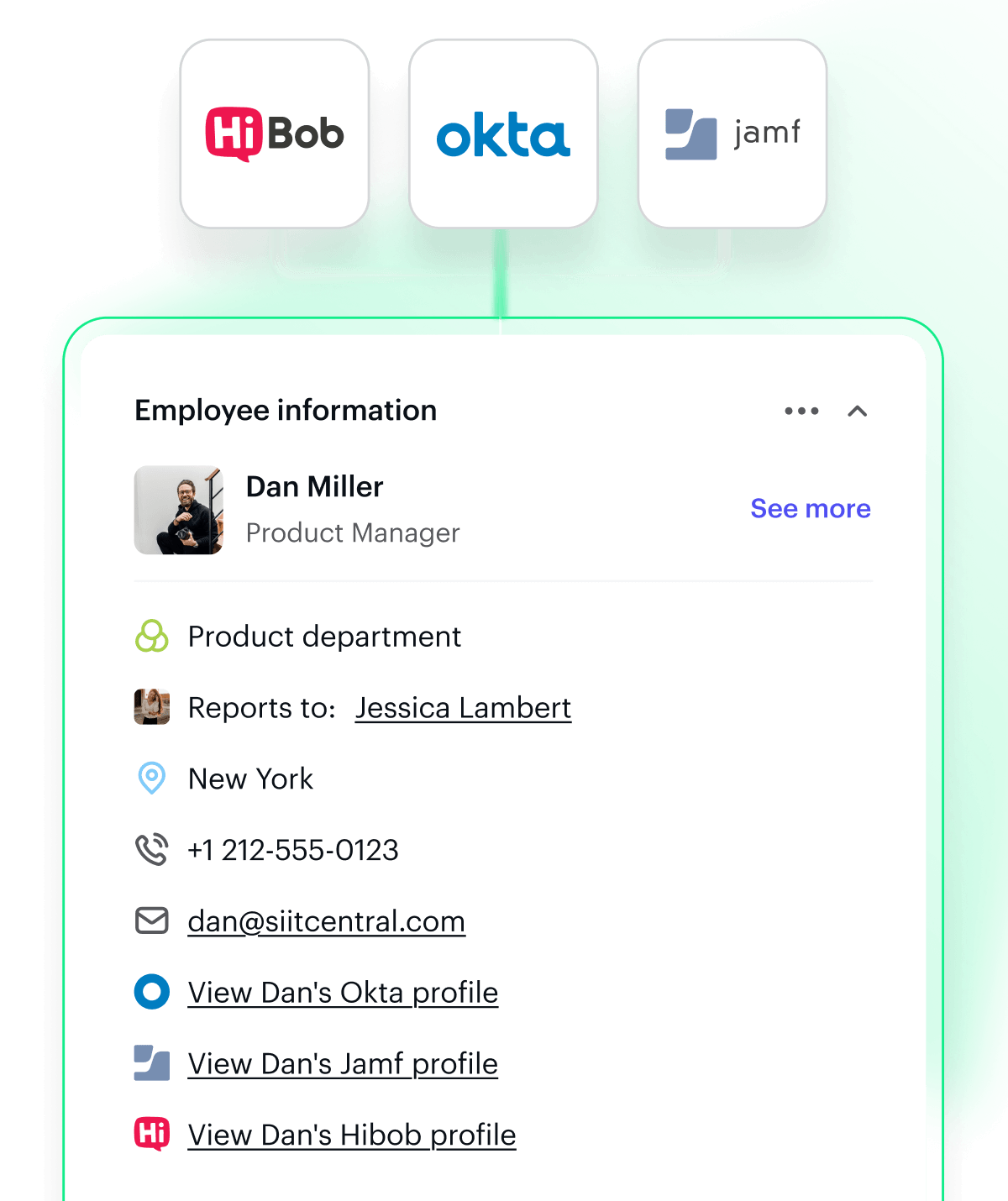
Siit maintains native objects for every employee: People linked to their Applications, Equipment, and Knowledge. That context exists before any request arrives. The agent already knows, and gets more accurate with every ticket resolved.
Compare features
Comparison
Features
Siit
Console
Data model
How employee context is stored and maintained
Siit
Persistent native objects. People, Applications, Equipment, and Knowledge maintained as structured records inside the platform. Context is owned by Siit and continuously updated, not fetched from external APIs at runtime.
Competitor
Stateless runtime fetch. Context assembled from Okta, Jamf, and Workday at execution time. No persistent data model inside Console.
Request context
What the agent knows before a request arrives
Siit
Pre-existing employee context. Role, devices, permissions, reporting chain, and access history are reconciled and available before any request fires. No real-time API lookups required at execution time.
Competitor
Assembled at execution. Console calls external APIs when a request fires. No pre-existing employee context inside the platform.
System reliability
What happens when upstream data is stale or unavailable
Siit
Platform-owned. If an external system is slow or unavailable, the AI agent still has the full employee context it needs to act. Execution does not depend on upstream API health at the moment of resolution.
Competitor
API-dependent. Stale directory records or failed API calls degrade resolution quality and accuracy at execution time.
Continuous improvement
How the system gets smarter over time
Siit
Compounding intelligence. Every resolved ticket feeds the knowledge layer. Triage accuracy improves, resolution patterns compound, and the system builds institutional knowledge continuously, not from isolated API responses.
Competitor
Admin-gated suggestions. Each system recommendation requires admin review and approval before going live. Improvement loops stall with limited admin bandwidth.

One system for every request. Not an automation layer on top of one.

Console started from AI automation and is building toward ITSM depth. It can automate IT requests and route escalations, but without native incident management, change management, asset tracking, or a service catalog, it cannot replace the ITSM underneath. The automation layer and the system of record remain separate.

Console deploys on top of your existing ITSM. Requests it resolves may never reach your system of record. Two platforms mean two queues, two data sets, and a reconciliation task that compounds with every reporting cycle.

Siit is the ITSM and the automation layer in one platform. Every request, whether resolved by AI, automated by workflow, or handled by a human, lands in the same system. One audit trail. One source of truth.

Compare features
Comparison
Features
Siit
Console
System of record
Where every request ultimately lives
Siit
Core ITSM. Every request, whether resolved by AI, automated by workflow, or handled by a human agent, lands in one platform. One source of truth, one audit trail, nothing to reconcile.
Competitor
 Automation overlay. Sits on top of your existing ITSM. Resolved requests may not sync to the downstream system of record.
Platform depth
What is native vs. what requires another tool underneath
Siit
Full native ITSM. Ticketing, service catalog, asset management, SLAs, workflow automation, and operational analytics are all built in. No underlying tool required.
Competitor
No ITSM depth. No native incident management, change management, asset tracking, or self-service catalog. Requires an existing ITSM for full lifecycle management.
Data reconciliation
What happens after each request
Siit
None required. Every event, automated or human-handled, lands in one system and feeds the same analytics and audit trail automatically. One set of numbers for leadership.
Competitor
Manual and structural. Requests Console handles may not land in your downstream ITSM. Teams reconcile metrics across systems every reporting cycle.
Analytics
Where operational data lives
Siit
Unified operational intelligence. Cost per request, SLA attainment, automation rates, and exec digests from one source. No cross-system data mapping or manual aggregation.
Competitor
Fragmented reporting. Console and your ITSM report separately. Unified metrics require manual aggregation outside both platforms.

Go live tomorrow,

not next quarter.

No CMDB rebuild. No service catalog migration. Connect your tools, define scope, and you’re live. Most teams are fully operational in days - not months

Book a demo

Orchestrate across departments. Not route tickets between them.

Console routes requests to the right department: IT, HR, Finance, or Legal. Routing is not orchestration. When a promotion triggers IT, HR, Finance, and Legal in parallel, each team gets a separate ticket, acts independently in its own workspace, and the employee waits.

Siit was built for cross-departmental orchestration from day one. A single request triggers parallel actions across IT, HR, Finance, and Legal, routing to the right approvers and completing end-to-end without manual coordination. Field-level governance means departments stay isolated on data but operate on the same platform.

Compare features
Comparison
Features
Siit
Console
Multi-team workflows
How a request spanning IT, HR, and Finance is handled
Siit
Native orchestration. A single request triggers parallel actions across IT, HR, Finance, and Legal, routes to the right approvers in each team, and completes end-to-end without manual coordination between departments.
Competitor
Routing only. Console routes requests to IT, HR, Finance, or Legal via AI router. Each department operates in its own workspace. No coordinated cross-team execution: each team acts independently.
Parallel approvals
How cross-department sign-offs are coordinated
Siit
Single coordinated process. Multi-step approvals across departments run in parallel within one workflow. One process, one audit trail, no manual handoff between teams or systems.
Competitor
Linear and siloed. Console's Playbooks execute one action at a time, whether built manually or generated by Console Assistant. Parallel cross-department approvals are not supported natively.
Governance
How data isolation works when departments share the platform
Siit
Field-level permissions by design. HR cannot see IT data and IT cannot see HR data, but both teams operate on the same platform. Departmental expansion carries no new security risk.
Competitor
Workspace-level isolation. Cross-department governance requires additional configuration and manual coordination per team.
Expansion path
What it takes to add HR, Finance, or Legal
Siit
No rebuild required. Start with IT and expand to HR, Finance, Legal, and Operations without rebuilding the platform or fragmenting the data model. One architecture that covers all departments.
Competitor
Separate deployment per team. Adding HR or Finance means a separate workspace, a separate Playbook set, and separate reconciliation.

See what happens when your service desk actually delivers.

Siit helped deflect 28% of support tickets that otherwise would have been handled by IT.

Ashley Brien
Tech Ops Support Lead at Monzo
25%
Requests automated
87%
SLA rate
160:1
Admin to employee ratio

Siit gives teams autonomy to manage their own requests and business processes without IT help.

Pauric Gallagher
Senior IT Operations Manager at Airalo
50%
Tickets automated
< 1 hr
Avg first response time
5x
Scale in employee headcount

Siit has improved our efficiency and cost-effectiveness on our internal help desk and helped us better support our employees.

Jared Allenbrand
Head of IT at Cresta
30%
Tickets automated
< 1 hr
Avg first response time
3x
Scale in employee headcount

See how Siit connects to your stack

Connect your existing tools. Go live without rebuilding a CMDB or migrating a service catalog.

Book a demo

FAQs

What is the difference between Siit and Console?

Siit is a full AI service desk built to handle IT, HR, Finance, and Legal requests in one platform, with ticketing, SLAs, asset management, and a unified employee data layer all native. Console is an IT automation platform built around Playbook execution and AI-driven request routing. The difference is scope and architecture: Siit can fully replace a legacy ITSM. Console does not cover the full surface area of a Freshservice or JSM today. Incident management, change management, asset management, and service catalog are not native.

Is Console a service desk or an IT automation tool?

Console calls itself an AI-Native ITSM, but its service desk capabilities do not yet cover the full lifecycle. There is no native incident management, change management, asset management, or self-service catalog. Companies that need to fully replace Freshservice or JSM today will find Console cannot cover that surface area. Siit was built as a complete service desk from day one, with AI layered in natively, not added on top.

What happens to requests Console cannot resolve?

Requests Console cannot automate are escalated to a human via Console's Inbox or routed to the existing ITSM. Console-resolved requests may not automatically sync to the downstream system of record, requiring manual reconciliation to keep metrics accurate across both platforms.

 Does switching to Siit require replacing an existing ITSM?

No. Siit integrates bidirectionally with existing ITSMs. Every request, whether Siit-automated or human-handled, syncs back to the existing system of record. Teams manage one queue and one data source instead of reconciling Console and a separate ITSM independently.

How does Siit's Unified Data Layer differ from Console's runtime context model?

Console assembles employee context from external APIs at the moment each request fires. If a directory record is stale or an API call fails, resolution degrades. Siit maintains persistent native objects for every employee inside the platform. The agent already knows who the employee is before any request arrives, and accuracy improves with every resolved ticket.