The 15 Best Procurement Software Tools for 2026
The best procurement software prevents the kind of surprise renewal Finance finds shortly after it auto-charged. Nobody remembers who approved the original contract, and the budget it is hitting had already run dry. If you lead an HR team, you have probably watched the same movie with a benefits platform or a recruiting tool nobody tracked.
The teams that fix this start with the approval chain first. Gorgias automated its promotion-request workflow so a single submission auto-fills the form and routes through the manager, the People VP, and payroll without anyone chasing it, reaching 100% adoption in two and a half weeks. Spendesk cut first response time on internal requests from over 24 hours to under 5 and now deflects 45% of payroll questions automatically.
This guide compares fifteen procurement platforms on approval depth, ERP integrations, sourcing capability, and segment fit, so you can bring purchasing under control without buying an enterprise suite you will never configure.
TL;DR:
- The right tool matches your approval complexity, vendor volume, ERP stack, and procurement maturity, in that order.
- Procure-to-pay tools like Precoro and Procurify cover most growing companies, while Coupa and SAP Ariba serve enterprises with dedicated procurement staff.
- Most of this category is only scoped through a sales conversation, so settle what has to be true on approval depth, ERP fit, and internal ownership before you book demos.
- Orchestration platforms are the newest category and the one to look at if the delay on your slowest purchases lands during parallel approvals, upstream of the PO.
What Are the Different Types of Procurement Software?
The category matters because the same "can we buy this?" request can become an onboarding task, a budget approval, a legal review, and an IT security check before procurement ever sees it. Five types are worth knowing, distinguished by how much of the purchasing lifecycle each covers.
- Source-to-Pay (S2P) handles everything from finding vendors to paying them: strategic sourcing, supplier evaluation, contract management, purchasing, and payment. Coupa and SAP Ariba sit here, geared toward organizations with formal procurement teams.
- Procure-to-Pay (P2P) focuses on the buying process itself: requests, approvals, PO generation, invoice matching, and payment. Procurify and Precoro fit here, and this is what most growing companies actually need.
- Procurement Orchestration (Intake-to-Procure) is the newest category and the fastest-moving. Platforms like Zip give employees one front door: they submit a single request, and the platform runs parallel approvals across Finance, Legal, IT, and Security before pushing the approved purchase into your ERP or P2P system. These earn their keep on requests that touch four departments before anyone can say yes.
- Contract Lifecycle Management (CLM) covers sourcing events, negotiation, renewal alerts, and a searchable contract repository. Some P2P tools bundle a basic repository; Zip and the enterprise suites build full contract workflows. If surprise auto-renewals are your biggest leak, weight this heavily.
- Spend Management tracks where money goes across the organization. Card-first platforms like Ramp and Brex live in this adjacent category, strong on corporate cards and AP automation but lighter on supplier management and sourcing.
One distinction cuts across all five: direct versus indirect spend. Direct spend covers materials that go into what you sell. Indirect spend covers everything that keeps the company running, from app subscriptions to office equipment and contractor services.
Legacy enterprise suites grew up around direct spend and physical supply chains, while orchestration platforms were built for indirect spend and the parallel approvals it triggers. If your purchasing is mostly SaaS seats and services, indirect-spend tooling fits better.
Top Procurement Software Tools: Comparison Table
Ratings are G2 averages taken from each product's own G2 page in August 2026, quoted without review counts because G2's own pages report different counts for the same product. Where G2 publishes no usable product-level score, the table says so, and the thin-coverage caveats sit in each tool's section below.
The 15 Best Procurement Tools
If HR is the team fielding "can we buy this?" pings, start with the tools that make employee requests visible before you compare enterprise sourcing depth.
1. Precoro
Precoro is a cloud-based procure-to-pay platform for small to mid-sized businesses, handling requisitions, PO management, and approval workflows without requiring procurement expertise.
Key features:
- Purchase requisition and PO management
- Multi-level approval workflows
- Budget tracking and spend analytics
- Mobile app for approvals
- QuickBooks Online, Xero, and Slack integrations on Core; NetSuite, Sage Intacct, and Dynamics 365 on higher tiers
Pros:
- Requisition-to-PO flow works without a procurement specialist on the team
- PunchOut catalogs for Amazon Business, Staples, Grainger, and other major suppliers
- Onboarding includes consultation sessions and training in a weeks-long rollout
Cons:
- AI document scanning and the AI copilot are not part of the base product
- Unlimited users and custom ERP integrations require Enterprise
- Built for fast setup over deep configurability
What users say: Precoro holds 4.7 out of 5 in G2 reviews, with a mid-market skew. Reviewers consistently single out the intuitive layout and the small amount of training needed to get approvers using it, and support responsiveness comes up repeatedly as a deciding factor. Capterra reviewers echo the fast transition from trial to live. The recurring gripe is narrower than the praise: interface changes that truncate long item descriptions, and approval configurability that reviewers describe as less granular than Procurify's once multiple legal entities are involved.
Best for: SMB to mid-market teams that want a fast rollout without a procurement specialist.
Not ideal for: Enterprises that need deep configurability across global entities.
2. Procurify
Procurify is a modular procure-to-pay platform that lets organizations start small and expand. It integrates with NetSuite and Sage Intacct for mid-market companies needing real-time spend visibility, and the Spending Card and mobile app round out a full intake-to-pay flow.
Key features:
- Real-time spend visibility dashboards
- Custom approval workflows
- Budget tracking by department and project
- Virtual card and expense management
- PunchOut catalogs plus QuickBooks Online, NetSuite, Sage Intacct, and Dynamics 365
Pros:
- Modular structure means you buy only the pieces you need now
- Mobile app keeps approvals moving
- Card and spend workflows can be added later without replatforming
Cons:
- Every deployment is scoped through a sales conversation
- Fast setup limits how deeply you can configure approval logic
- Sourcing and RFx depth is not the focus
What users say: Procurify scores 4.6 out of 5 among G2 reviewers, who cite ease of use and time-saving features as beneficial. Implementation speed draws unusually specific praise, with reviewers reporting multi-entity rollouts completed inside the standard onboarding process. The complaints cluster in two places: reviewers say simple tasks can take too many steps, and searching historical requests or POs is harder than it should be. Correcting a request entered wrong is another repeated friction point. Inventory management is the most-requested missing capability.
Best for: Mid-market teams that want spend control without an ERP project.
Not ideal for: Enterprises that need full source-to-pay sourcing depth.
3. Vroozi
Vroozi is an AI-powered procure-to-pay platform with a supplier marketplace and unified catalog browsing, built for organizations that want invoice automation and real-time spend analytics. Among the mid-market tools here, it leans hardest into AI-driven document processing.
Key features:
- Supplier marketplace with unified catalog browsing
- Purchase request and PO management
- AP automation with AI-powered invoice processing
- Real-time spend analytics
Pros:
- AI invoice processing reduces manual document handling
- Strong fit for teams standardizing catalog-based purchasing
- Marketplace shortens supplier onboarding
Cons:
- Scope depends on which modules and transaction volumes you contract for
- Fewer visible buyer-reference signals than Precoro or Procurify
- Enterprise source-to-pay depth is thinner than the dedicated suites
What users say: Review coverage is thin. Vroozi has far fewer public reviews than Precoro or Procurify, which means less independent signal on how the AI invoice processing performs on messy real-world documents. Weigh your own reference calls more heavily to compensate.
Best for: Teams where invoice and document intake is the bottleneck.
Not ideal for: Buyers who need scope clarity before the first sales call.
4. Pipefy
Pipefy is a no-code workflow platform with procurement and finance capabilities, built for teams that want custom procurement workflows without technical expertise. That flexibility cuts both ways: you are configuring a workflow engine, not unboxing a dedicated procurement suite.
Key features:
- Configurable approval workflows
- Procure-to-pay process automation
- Customizable forms and workflows
- Real-time budget tracking and reporting
Pros:
- No-code builder your team can run without engineering help
- Flexes beyond procurement into HR and finance processes
- G2 reviewers rate it 4.6 out of 5 and score ease of use above the category average
Cons:
- General-purpose workflow platform, not a dedicated procurement suite
- Supplier catalogs and PO-invoice matching need configuring before they work
- Plan limits on processes, users, and stored records apply below the top plans
What users say: Pipefy sits at 4.6 out of 5 among G2 reviewers, who score ease of use above the category average and repeatedly praise public forms for collecting requests from people outside the tool. The consistent limitation reviewers raise is depth in connection fields, where only one linked record is supported. Because Pipefy is a workflow engine at heart, reviewer satisfaction tracks closely with how much configuration work a team was willing to do up front.
Best for: Teams that want to design their own purchasing workflows.
Not ideal for: Buyers who want out-of-the-box PO matching and supplier catalogs.
5. Coupa
Coupa is a cloud-based source-to-pay platform for large enterprises with dedicated procurement teams, covering strategic sourcing through payment with AI-powered automation and a global supplier network. Its customer roster includes Uber, Microsoft, Reddit, and American Airlines.
Key features:
- Unified source-to-pay platform
- Global supplier network with community-sourced spend benchmarks
- Contract lifecycle management
- AI-driven spend analytics and savings tracking
Pros:
- Broadest supplier network in the category
- Full sourcing, contract, and payment coverage in one platform
- Benchmarking data that smaller platforms cannot match
Cons:
- Implementations run as enterprise-scale projects
- Requires dedicated procurement staff to realize the value
- Overkill for companies without a formal sourcing function
What users say: Coupa averages 4.2 out of 5 among G2 reviewers, a majority of them at enterprise scale, and the complaint pattern is quantified enough to plan around. Missing features, particularly in travel expense reporting, appear across several mentions. Complexity made worse by poor documentation is also present, as well as a difficult learning curve around configuration and workflow management. Reviewers who like it point to single-screen visibility and automation depth. The signal most buyers miss sits on the supplier side: vendors required to transact through Coupa describe the experience as poor, which matters if supplier adoption is part of your business case.
Best for: Large enterprises with a procurement team and global supplier base.
Not ideal for: Growing companies whose spend is mostly SaaS and services.
6. SAP Ariba
SAP Ariba is an enterprise source-to-pay suite with the deepest native integration into the SAP stack, built around the Ariba Network for supplier collaboration.
Key features:
- Native S/4HANA and SAP ERP integration
- Ariba Network for supplier discovery and collaboration
- Strategic sourcing and contract management
- Guided buying for catalog and non-catalog purchases
Pros:
- Unmatched fit if SAP is already your ERP
- Mature supplier network with global reach
- Handles direct and indirect spend in one suite
Cons:
- Deployment scope depends on modules and existing SAP licensing
- Implementation timelines and consulting effort are substantial
- Interface complexity means non-procurement staff need training
What users say: Ariba draws 4.1 out of 5 among G2 reviewers. The praise is consistent and narrow: real-time data flow with SAP ERP, the reach of the Ariba Network, and reliable tracking of purchase requests through approval. So is the criticism. Reviewers describe the interface as dated and unintuitive, flag a steep learning curve for new users, and report occasional slow performance. Ariba is the clearest case in this list where a strong feature set and weak day-to-day usability coexist.
Best for: Companies already running SAP that want procurement on the same platform.
Not ideal for: Non-SAP organizations, where the integration advantage disappears.
7. Tradogram
Tradogram is a procurement platform that brings RFQ and RFP workflows within reach of a small team, with the sourcing modules sold as add-ons.
Key features:
- RFQ and RFP management with supplier comparison
- Purchase order and requisition workflows
- Supplier and contract records
- Spend reporting by department
Pros:
- Purchase orders, AP invoices, and expense capture come as standard
- Sourcing workflows usually reserved for enterprise suites
- Requisitions and RFx events available as add-ons on the entry plan
Cons:
- Interface is more functional than polished
- Reporting depth trails the mid-market platforms
- Smaller partner and integration ecosystem
What users say: Tradogram scored 4.3 out of 5 on G2, though public review coverage is limited compared with the mid-market platforms, so there is less independent evidence on how the RFQ workflows hold up at volume. Weight your own reference calls with teams running sourcing events at your volume.
Best for: SMB teams that need real sourcing workflows without an enterprise suite.
Not ideal for: Teams that want a modern interface and deep analytics.
8. Spendwise
Spendwise is a straightforward purchasing and inventory system for small teams moving off paper and spreadsheets, with QuickBooks as its anchor integration.
Key features:
- Purchase order creation and tracking
- Approval routing
- Inventory and item records
- QuickBooks integration
Pros:
- QuickBooks sync covers the accounting handoff for small finance teams
- Fast setup with minimal configuration
- Straightforward enough that occasional approvers can use it
Cons:
- Limited automation and no AI features
- Thin analytics and reporting
- Not built for multi-entity or international operations
What users say: Review volume is low, which is typical for tools serving very small teams, though it scores 4.7 out of 5 on G2. There is little independent signal on support responsiveness or how the QuickBooks sync behaves at month-end close, both of which are worth testing directly during a trial.
Best for: Small teams replacing paper POs and spreadsheet tracking.
Not ideal for: Companies that need spend analytics or multi-entity support.
9. NetSuite Procurement
NetSuite Procurement is Oracle's procurement module for companies already running NetSuite ERP, keeping purchasing and financial records in one system.
Key features:
- Requisition and PO workflows inside NetSuite
- Three-way matching against receipts and invoices
- Vendor records tied to the general ledger
- Native financial reporting
Pros:
- No integration work if NetSuite is your ERP
- Purchasing and financials share one data model
- Approval routing inherits existing NetSuite roles
Cons:
- Only makes sense as a NetSuite add-on
- Sourcing and RFx capabilities are limited compared with dedicated suites
- No standalone review coverage, so evaluation rests on NetSuite references
What users say: Reviews rarely separate the procurement module from NetSuite as a whole, so sentiment about it is really sentiment about your ERP. That makes existing NetSuite users your most useful reference source, specifically on whether approval routing was flexible enough without customization.
Best for: Existing NetSuite customers consolidating purchasing into their ERP.
Not ideal for: Anyone not already committed to NetSuite.
10. Ivalua
Ivalua is a highly configurable source-to-pay platform for enterprises with requirements that off-the-shelf suites cannot accommodate.
Key features:
- Configurable source-to-pay across all spend categories
- Supplier risk and performance management
- Contract lifecycle management
- Direct and indirect spend in one platform
Pros:
- Configurability handles unusual approval and category structures
- Strong supplier risk management
- Analyst recognition in enterprise procurement evaluations
Cons:
- Mid-market reference customers are hard to find
- Configurability means implementation effort and specialist skills
- Too heavy for companies without a procurement function
What users say: Ivalua scores 4.3 out of 5 on G2, though the reviewer base is rather limited. The pattern in the reviews is coherent: configurability earns genuine praise, and the same configurability generates complexity complaints at implementation. G2's comparison data puts it behind Jaggaer on procure-to-pay execution while ahead on depth of configuration. Reviewers outside the enterprise segment are scarce enough that mid-market buyers should discount the ratings and rely on references at their own size.
Best for: Enterprises with complex, non-standard procurement requirements.
Not ideal for: Teams that want to be live in weeks.
11. Tipalti
Tipalti is an AP automation and global payables platform, strongest when you are paying vendors and contractors across many countries and currencies.
Key features:
- Payments across 196 countries and 120+ currencies
- Supplier onboarding with tax and compliance collection
- Invoice capture and approval workflows
- PO matching and AP automation
Pros:
- Global payables coverage no other tool here matches
- Tax form collection and compliance handled automatically
- Payables workflow runs end to end without a separate AP tool
Cons:
- AP and payments focus, so sourcing and supplier management are thin
- Requisitions and purchase approvals are not part of the product
- Sourcing events have to run somewhere else entirely
What users say: Tipalti earns 4.5 out of 5 in G2 reviews, a mid-market-weighted base, and scores 8.7 on ease of use, ahead of the enterprise suites here. Reviewers value the accounting-system integrations and the onboarding experience for new users. The consistent caveat concerns scope: reviewers who wanted sourcing or supplier management found it thinner than the payables capability that drew them in.
Best for: Companies paying international vendors and contractors at volume.
Not ideal for: Teams whose main need is sourcing or contract management.
12. Zip
Zip is a procurement orchestration platform that gives employees one intake front door and runs parallel approvals across Finance, Legal, IT, and Security before pushing approved purchases into your ERP or P2P system.
Key features:
- Single intake form routed by request type and amount
- Parallel approval workflows across departments
- Contract repository with renewal alerts
- Integrations that push approved purchases into ERP and P2P systems
Pros:
- Built for the parallel-approval problem that stalls indirect spend
- Layers onto your existing stack with no replatforming
- Contract and renewal visibility included
Cons:
- Contracts are scoped by request volume, integrations, and modules
- Assumes you already have a downstream P2P or ERP system
- Aimed at mid-market and enterprise buyers, so small teams are a poor fit
What users say: Zip holds 4.6 out of 5 among G2 reviewers, skewed mid-market, and beats Ariba on ease of use in direct comparisons. Reviewers highlight visibility at every approval step and describe the workflows as straightforward to configure, which is what drives the broad internal adoption the category depends on. The review base is small in absolute terms, reflecting how new orchestration is as a category.
Best for: Companies whose purchases stall in cross-functional approvals.
Not ideal for: Teams that need a straightforward PO system.
13. Jaggaer
Jaggaer is an enterprise source-to-pay suite with particular strength in supply chain, manufacturing, and ESG reporting requirements.
Key features:
- JAGGAER ONE source-to-pay suite
- Supplier management with ESG and risk data
- Sourcing and auction capabilities
- Category-specific workflows for manufacturing and public sector
Pros:
- Deep supplier and supply-chain capability
- ESG and compliance reporting built in
- Strong fit for direct-spend-heavy organizations
Cons:
- Deployment is scoped per module and spend category, which slows evaluation
- Enterprise implementation timelines
- Indirect-spend and SaaS purchasing are not the design center
What users say: Jaggaer sits at 4.1 out of 5 on G2, a small base concentrated in large enterprises with complex direct and indirect spend. Reviewers praise flexibility, sourcing depth, and faster time-to-value than the configuration-heavy suites, and independent comparisons score it 9.0 on procure-to-pay execution. Adoption among SMB and fast-moving mid-market teams is limited enough that reviews from companies your size may be hard to find.
Best for: Enterprises with supply chain complexity and ESG obligations.
Not ideal for: Companies whose spend is mostly software and services.
14. GEP
GEP is a unified source-to-pay platform combining software with GEP's procurement consulting and managed services.
Key features:
- AI-assisted sourcing and spend analysis
- Unified direct and indirect spend management
- Contract and supplier lifecycle management
- Consulting and managed services alongside the platform
Pros:
- Software plus services model suits teams without deep procurement expertise
- Single unified platform across sourcing, contracts, and payments
- Consistent analyst recognition in enterprise sourcing
Cons:
- Reviewers score ease of use and integrations well below workflow and support
- Services-led model means longer sales and implementation cycles
- Heavier than growing companies need
What users say: GEP rates 4.3 out of 5 on G2 with a limited number of reviews, so treat the score as directional rather than settled. Within that base, workflow management scores 9.0 and support quality 8.8, both strong, while ease of use at 8.1 and integrations at 7.7 trail. Reviewers describe implementations as transformation projects requiring substantial professional services, which fits the services-led model they sell.
Best for: Enterprise sourcing teams that want consulting alongside software.
Not ideal for: Buyers who want to self-serve and go live quickly.
15. Zycus
Zycus is a source-to-pay suite built around agentic AI, with a conversational interface across sourcing, contracts, and savings tracking.
Key features:
- Agentic AI with a conversational interface
- Sourcing, contract, and supplier management
- Savings tracking and spend analytics
- Guided buying for requesters
Pros:
- AI capability is central to the product rather than bolted on
- Savings tracking ties procurement work to financial outcomes
- Conversational interface lowers the barrier for occasional requesters
Cons:
- Lowest G2 score in this list, at 3.6 out of 5
- Enterprise implementation effort and change management
- Smaller footprint than Coupa or Ariba in some regions
What users say: Zycus rates around 3.6 out of 5 among a very limited number of reviews on G2. Reviewers are drawn by the AI capability; the tradeoffs they report concentrate in delivery and support. Worth a shortlist slot if AI-assisted sourcing is the priority, with support expectations tested carefully in references.
Best for: Procurement teams that want AI-assisted sourcing and measurable savings tracking.
Not ideal for: Small teams that need a simple PO system.
How to Choose the Best Procurement Software
When evaluating procurement software, prioritize these five factors to find the right fit:
- Approval depth: Map your longest real approval chain, including parallel Finance, Legal, and IT reviews, then confirm the platform models it without custom development.
- Automation realism: Prioritize proven features over marketing promises. Always test "agentic" AI and extraction capabilities with your own data to see how they perform in real-world scenarios.
- Contract and risk management: Assess whether you require a simple repository or a complex system for tracking renewals. Ensure the solution supports proactive, actionable alerts.
- Integration reliability: Verify native connectivity with your core stack. Test bidirectional data flows during a trial to ensure they sync accurately with your existing systems.
- Organizational fit: Align the platform's complexity with your current maturity. Avoid enterprise suites if you lack the dedicated staff to configure and maintain them.
How Siit Handles Requests Before They Reach Procurement
Procurement software handles the vendor side: POs, supplier management, invoice matching, and spend tracking. The slowest part of most purchases happens before a request ever reaches it.
A new hire needs a software seat. They message their manager on Slack. The manager forwards it to IT for a policy check. IT pings Finance for budget confirmation. Finance asks HR to verify the role and start date. After four handoffs, someone finally creates the purchase request, and procurement sees a clean submission that took a week to produce.
Siit is an AI service desk that handles the upstream layer in Slack and Teams. A request arrives where the employee already works. Siit reads role, department, and start-date context synced from your HRIS, routes approvals by request type and amount, and keeps the full chain in one thread with an audit trail attached. Unit runs this pattern with tiered thresholds: routine applications approve automatically, standard ones need the manager plus the app owner, and sensitive systems add the COO.
The licensing model matters for an intake layer specifically, because everyone who submits or approves a purchase touches it. Siit charges for admins only, so requesters, approvers, and followers never consume a license and employee use stays unlimited. Rule-based routing, HRIS and MDM integrations, SLA management, and AI Triage are available as the volume grows.
Getting Started With Procurement Workflow Automation
Most bad procurement purchases are not the wrong category. They are the right category at the wrong size: a source-to-pay suite bought by a company with no sourcing function, then configured by nobody and abandoned by everybody. Most of the platforms here will not scope a deployment without a sales cycle, which makes it easy to spend months evaluating tools that were never built for a team your shape.
There is a cheaper diagnostic than a demo queue. Look at your last five purchases and find where each one actually stalled. If the delay was PO generation, invoice matching, or a supplier record nobody owned, buy from this list by segment fit and check the integration map against your ERP. If the delay was the week of Slack messages before the request existed, no procurement platform will touch it, because the problem happens upstream of the first field anyone fills in.
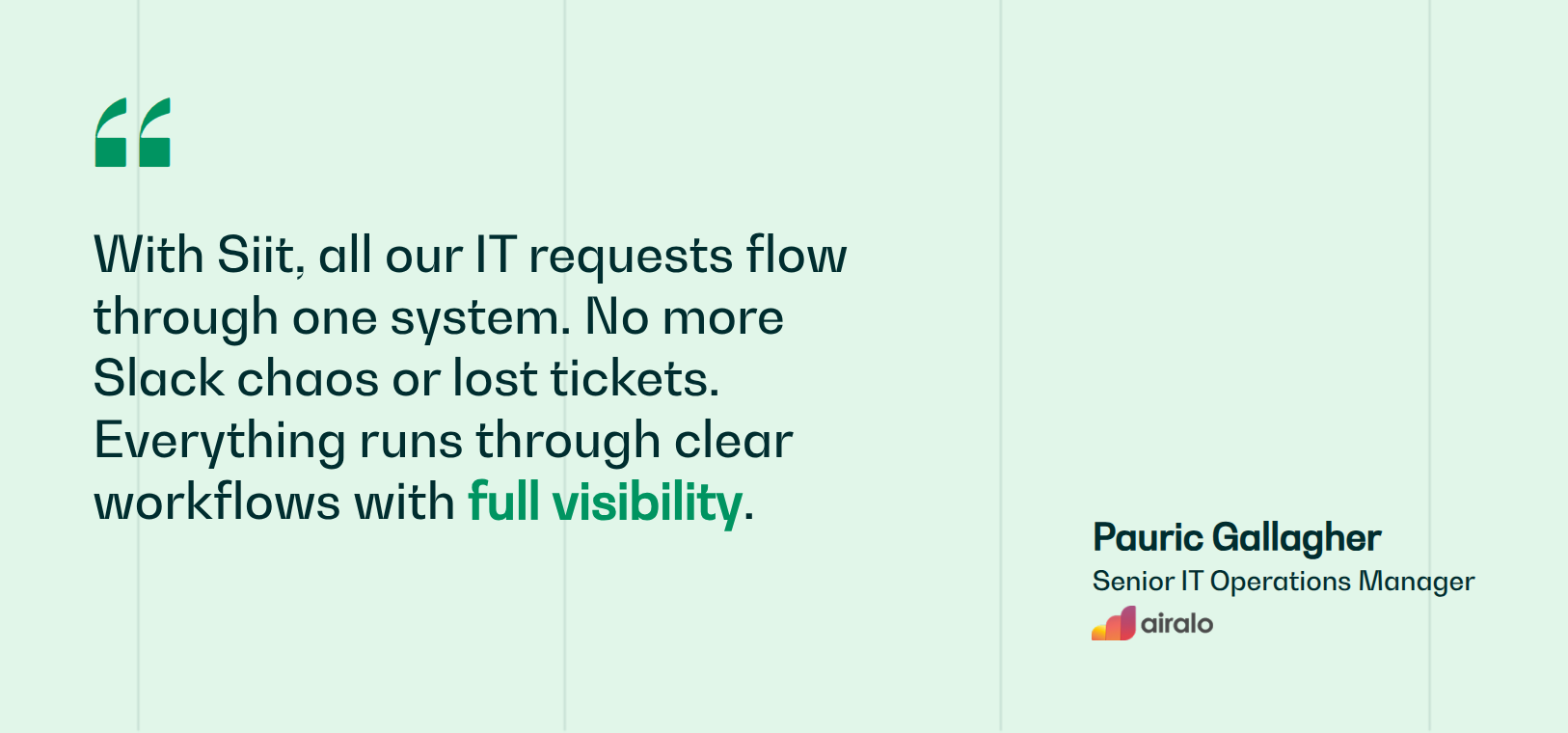
Airalo's IT team found the second version. Requests were arriving through direct messages and threads, so nobody could say what was pending or who owned it. Routing everything through one tracked system meant ticket volume could triple in their first year on Siit while satisfaction held at 90%, because a workflow absorbed the growth.
Book a demo to see how Siit routes employee purchase requests and approvals from Slack or Teams.



FAQ

Ownership usually sits with Finance, since approval thresholds and vendor records live there. IT owns the integrations and access reviews, and HR triggers a large share of requests through onboarding and role changes. The pattern that works is one owner for configuration plus named approvers per spend category, agreed before rollout. Teams that skip that step end up with a platform nobody maintains and approval chains that stall on whoever is out that week.
Procure-to-pay covers the buying process from purchase request through payment: approvals, PO generation, invoice matching. Source-to-pay adds everything upstream of the purchase, including strategic sourcing, supplier discovery and evaluation, and contract negotiation. The practical test is whether you run competitive sourcing events. If you do, you need source-to-pay. If your purchasing is mostly renewals and known vendors, procure-to-pay covers it with far less complexity.
Below roughly 30 employees, a shared spreadsheet and a clear approval rule usually hold. The signals that you have outgrown that are specific: you cannot answer who approved a given purchase, a renewal charged without anyone noticing, or Finance discovers committed spend after the fact. Any one of those means the record-keeping has failed, and that is the point where a purpose-built tool starts paying for itself.
No, and vendors that imply otherwise are overselling. Procurement platforms manage purchasing workflows and vendor data, then push transactions into the ERP that owns your general ledger and financial reporting. Some ERPs, including NetSuite, sell procurement as a module, which keeps everything in one system while sourcing capability stays thinner. Standalone procurement tools go deeper on sourcing and approvals but require a working ERP integration.
SMB-focused tools are typically live in weeks, with vendor-led onboarding and training included. Enterprise source-to-pay suites run months and usually require an implementation partner, because the work is not installing software but agreeing on approval thresholds, spend categories, and supplier data standards across departments. Teams that shorten this launch one spend category first, prove the approval flow holds, then add the rest.