Siit vs. Jira Service Management

JSM creates Jira issues. Siit resolves requests, connecting your HRIS, identity provider, MDM, and Atlassian stack to complete the action before an agent opens the queue.

Book a demo

Why companies switch from
Jira Service Management to Siit

Your AI knows the employee. No CMDB required.

JSM manages requests as Jira issues. Linking real employee context requires building Assets schemas and manual sync schedules. Connecting IAM systems like Okta or Entra ID for access provisioning requires custom development or third-party middleware, making end-to-end automation difficult to achieve natively.

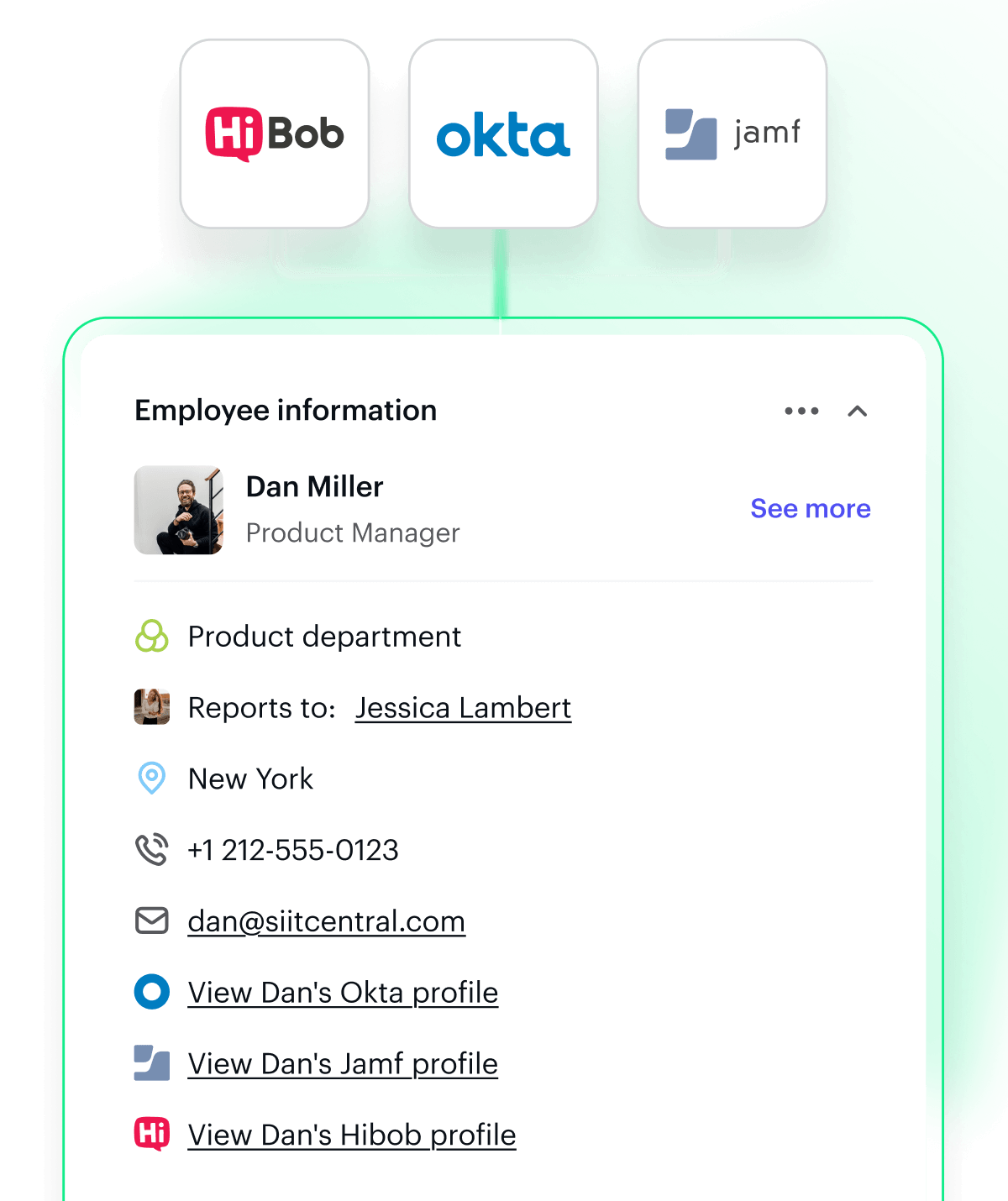
Siit syncs your HRIS, IdP, and MDM into one live employee profile. The AI knows role, devices, and permissions the moment a request arrives, no CMDB required.
Compare features
Comparison
Features
Siit
Jira Service Management
Data strategy
How employee data flows into resolution
Siit
Unified and live. Natively syncs real-time context from HRIS, IdP, MDM, and SaaS tools into a single employee profile. Full operational context present at the moment a request arrives, without schema setup or manual sync.
Competitor
Issue-centric + CMDB. Requires constructing object schemas and maintaining manual sync schedules. Employee context is not natively available at resolution time.
Employee context
What the AI sees at resolution time
Siit
Full employee profile (department, role, manager, permissions, devices, app access, ticket history) assembled automatically from connected systems at the moment a request arrives.
Competitor
Fragmented across Jira fields and admin consoles. Agents reconstruct context ticket by ticket.
SaaS asset visibility
Who has access to what
Siit
Identity-centric. Live access visibility via IdP and MDM integrations, telling you who has access to which apps across your SaaS stack, updated in real time, without manual cross-referencing.
Competitor
Object-centric CMDB. SaaS access tracked as manually mapped objects. Consumption pricing applies above 50,000 tracked objects.
Integration depth
What connected systems can do
Siit
Bidirectional execution. Siit reads from and writes to connected systems, pulling context and executing actions (provisioning, deprovisioning, onboarding triggers) without custom middleware.
Competitor
Not native. Connecting Okta or Entra ID for access provisioning requires third-party middleware or custom development.

AI that executes the work. Not just assists with it.

Rovo and Atlassian Intelligence help agents draft replies, but draw only from Atlassian data. Provisioning in Okta or triggering cross-system onboarding still falls back to your team.

Siit's AI agents complete the action end-to-end, provisioning access, routing approvals, and confirming back to the employee. Over 50% of tickets resolved autonomously across IT, HR, Finance, and Legal.

Compare features
Comparison
Features
Siit
Jira Service Management
Automation type
How AI helps resolve requests
Siit
AI agents provision access, trigger onboarding, reset passwords, and complete multi-step workflows end-to-end across Okta, Google Workspace, Jamf, Workday, Jira Software, and connected systems without human intervention.
Competitor
Rule-based + AI-assisted. Knowledge deflection and drafting only. Cross-system execution requires additional configuration and human follow-through.
AI scope
What the AI can see and use
Siit
Ecosystem-agnostic. AI draws on data from HRIS, IdP, MDM, Atlassian tools, and any connected system. Every resolution carries unified operational context regardless of which vendors are in your stack.
Competitor
Atlassian-bounded. Rovo draws exclusively from the Atlassian knowledge graph. HRIS, IdP, and MDM data are outside its native scope.
Workflow execution
How multi-step tasks get completed
Siit
End-to-end autonomous. A single request can span identity provisioning, manager approval, license check, and employee confirmation, all completed by the AI across connected systems without rebuilding logic per project.
Competitor
Pre-configured rules per project. Cannot be reused across teams or workspaces. Each deployment rebuilt from scratch.
Cross-department operations
Extending service ops beyond IT
Siit
IT, HR, Finance, and Legal on a single operational layer. Teams collaborate on tickets across departments with shared routing and private channels for confidentiality. No siloed project spaces, no manual workarounds.
Competitor
Project-based silos. Cross-team routing requires manual workarounds. Non-technical teams routinely resist portal adoption.

Go live tomorrow,

not next quarter.

No CMDB rebuild. No service catalog migration. Connext your tools, define scope, and you’re live. Most teams are fully operational in days - not months

Book a demo

Ecosystem-Agnostic Operations

JSM's AI features work best with the full Atlassian stack. Teams running Notion, non-Atlassian IdPs, or third-party MDMs access only partial capability without broader Atlassian adoption.

Siit connects natively with Jira Software, Confluence, and Bitbucket, keeping your Atlassian investment intact. It works equally well with any HRIS, IdP, or MDM in your stack.
Compare features
Comparison
Features
Siit
Jira Service Management
Ecosystem dependency
What the platform requires to work fully
Siit
Ecosystem-agnostic. Works with any combination of tools like Notion or Confluence, Okta or Entra ID, Jamf or Intune, BambooHR or Workday. Same unified data model and AI execution regardless of vendor mix.
Competitor
Atlassian-optimized. AI features work best when Confluence, Jira Software, and Opsgenie are all in use. External stacks get partial capability.
Atlassian compatibility
Working with your existing Jira environment
Siit
Native integrations with Jira Software, Confluence, and Bitbucket. Engineering keeps Jira Software. Your knowledge base stays in Confluence. Siit becomes the operational layer that connects everything, no ecosystem switch required.
Competitor
Atlassian-optimized. Full AI capability requires Confluence, Jira Software, and Opsgenie to be in use. Teams with non-Atlassian knowledge bases, IdPs, or MDMs access only partial functionality.
Pricing model
How costs scale as you grow
Siit
Predictable SaaS. Per-admin pricing with unlimited requesters. No consumption fees on knowledge objects, no variable charges on AI feature usage. Cost scales with your team, not with ticket volume or asset counts.
Competitor
Variable consumption. Agent seats plus overage fees on Assets above 50,000 objects. Threshold reached faster than expected as teams scale.
Implementation
Time from contract to live operations
Siit
Agile deployment, typically measured in weeks. Integration-driven setup, no CMDB to build, no Jira project schemas to reconstruct, no certified administrators required. Migration focuses on connecting identity systems and HRIS platforms.
Competitor
Months for complex deployments. Configurations not reusable across projects. Certified Jira administrators recommended.

See what happens when your service desk actually delivers.

Siit helped deflect 28% of support tickets that otherwise would have been handled by IT.

Ashley Brien
Tech Ops Support Lead at Monzo
25%
Requests automated
87%
SLA rate
160:1
Admin to employee ratio

Siit gives teams autonomy to manage their own requests and business processes without IT help.

Pauric Gallagher
Senior IT Operations Manager at Airalo
50%
Tickets automated
< 1 hr
Avg first response time
5x
Scale in employee headcount

Siit has improved our efficiency and cost-effectiveness on our internal help desk and helped us better support our employees.

Jared Allenbrand
Head of IT at Cresta
30%
Tickets automated
< 1 hr
Avg first response time
3x
Scale in employee headcount

See how Siit connects to your stack

Connect your existing tools. Go live without rebuilding a CMDB or migrating a service catalog.

Book a demo

FAQs

What is the difference between Siit and Jira Service Management?

Jira Service Management is an issue-tracking platform extended into ITSM, where requests become Jira issues routed through projects and queues. Siit is an AI service desk that resolves requests by executing actions across your operational stack: provisioning in Okta, triggering onboarding in Workday, updating devices in Jamf without agent intervention.

Does Siit work with Jira Software and Confluence?

Yes. Siit integrates natively with Jira Software, Confluence, and Bitbucket. Engineering keeps Jira. Your knowledge base stays in Confluence. Siit becomes the operational layer connecting your Atlassian tools to the rest of your stack (HRIS, IdP, and MDM) without requiring a migration away from Atlassian.

Can Siit replace Jira Service Management?

Yes. Because Siit integrates natively with Jira Software and Confluence, migration focuses on connecting your HRIS and identity systems, not rebuilding service catalogs or Jira project structures. Monzo and Supercell both replaced JSM with Siit. Most teams are live within weeks.

How is Siit different from Atlassian Assist in Slack?

Atlassian Assist bridges Slack and Jira, but complex workflows redirect users to the Jira portal to complete the action. Siit is built as a chat-native platform. Dynamic approvals, custom forms, and AI execution happen entirely within Slack or Teams, with no portal redirect required.

How fast can teams go live with Siit after leaving JSM?

Most teams are live within weeks. Because Siit integrates natively with Jira Software and Confluence, migration focuses on connecting your HRIS and identity systems, not rebuilding a CMDB or recreating Jira project schemas from scratch.