Siit vs. Serval

Serval lives on top of your ITSM. Siit is your ITSM.

Book a demo

Why companies switch from
Serval to Siit

Automation that scales. No codebase to maintain.

Serval generates TypeScript workflows your team must own. Fast to start, but every automation becomes a maintenance liability when an API changes or the person who built it moves on.

Siit's no-code, event-driven workflow builder is platform-managed. Your team defines the rules. Siit handles the integration logic. When your stack changes, the platform adapts.
Compare features
Comparison
Features
Siit
Serval
Workflow builder
How automations are created
Siit
No-code, event-driven builder. Triggered by HRIS events, requests, or schedules. No coding required at any stage. Your team configures the logic, the platform executes it.
Competitor
Vibe coding. Generates TypeScript that needs engineering review and version control before deployment.
Automation ownership
Who maintains automations over time
Siit
Platform-managed. Siit maintains all integration logic. Zero engineering responsibility for the customer. Your team stays focused on outcomes, not code.
Competitor
Customer-owned code. Your team debugs, versions, and updates every generated workflow.
API changes
What happens when your stack evolves
Siit
Platform absorbs it. When a connected system updates its API, Siit handles the change. No customer action required, no automation downtime.
Competitor
Customer absorbs it. Affected automations must be found, fixed, and redeployed manually.
Long-term scalability
Running automation number 200
Siit
No compounding overhead. The 200th workflow is as easy to maintain as the first. The platform manages the integration layer regardless of automation volume.
Competitor
Compounding debt. Maintenance responsibility grows with every automation added.

Every automation runs on verified, unified data, not stale data.

Serval pulls from Okta, Jamf, and your HRIS to inform routing and eligibility. The integrations are real, but automation quality is only as good as the data behind them. When HRIS roles lag or Okta groups go stale, Serval acts on inaccurate inputs with no visible reconciliation before the action runs.

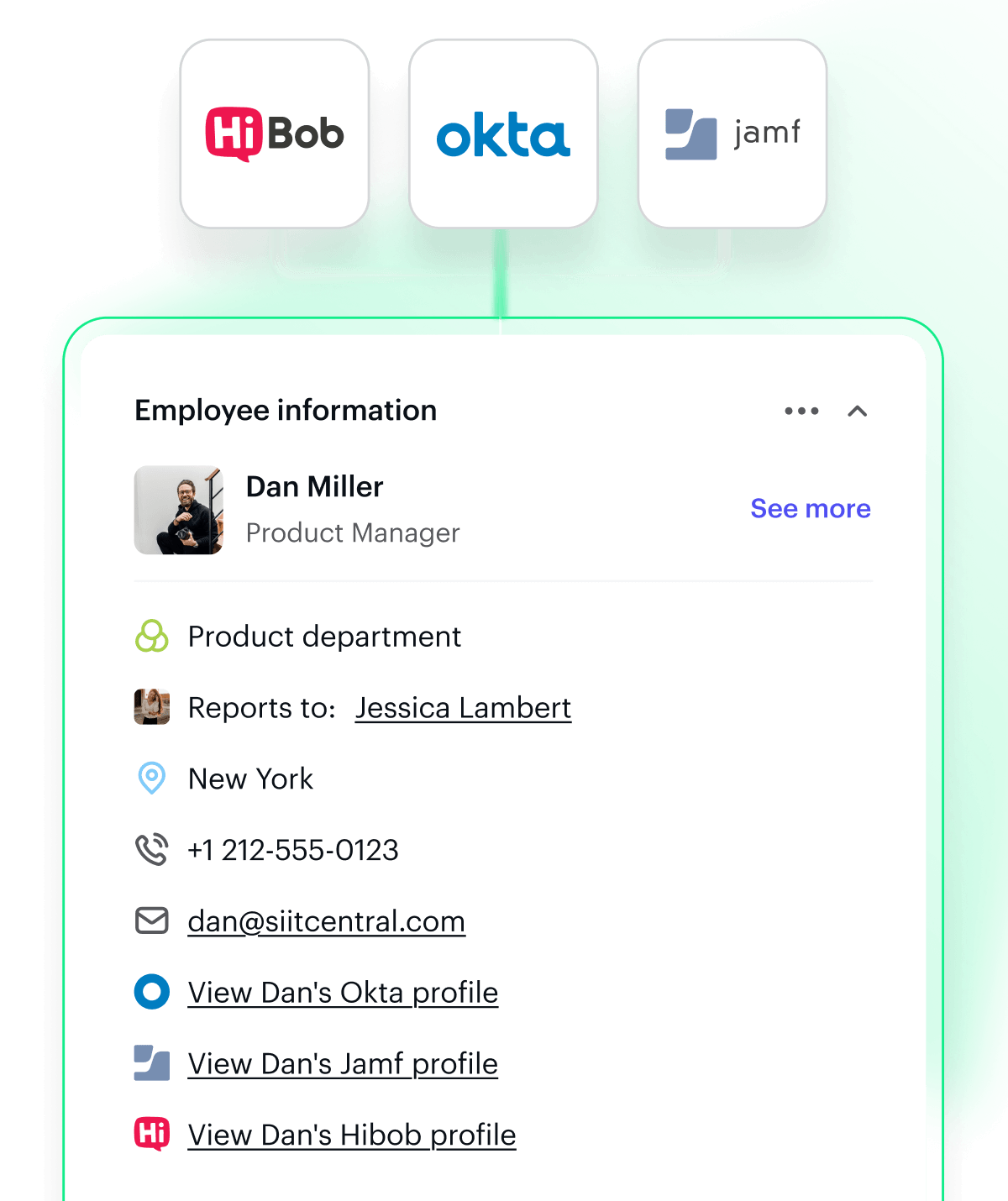
Siit's Unified Data Layer connects HRIS, IAM/IdP, and MDM into a single reconciled foundation. Every request automatically has full employee context, role, devices, permissions, and reporting chain, all verified before any agent acts. This is not a per-workflow configuration. It is the foundation every automation runs on.

Compare features
Comparison
Features
Siit
Serval
Data model
How employee context informs every request
Siit
Unified data layer. HRIS, IAM/IdP, and MDM connected into a single operational layer. Every request gets full employee context automatically, with no per-workflow configuration required.
Competitor
Multi-source ingest. Automation accuracy depends on consistency of identity and HR data.
Data conflicts
What happens when HRIS and IdP disagree
Siit
Caught at the foundation. Conflicts between HRIS roles and IdP group assignments surface before any agent acts. No confident provisioning of wrong permissions.
Competitor
Acted on, not reconciled. Stale groups or lagging role data can trigger wrong access decisions.
Access management
How provisioning and permissions are governed
Siit
Context-first provisioning. Role, devices, reporting chain, and app access reconciled before any action runs. Reliability comes from a unified data foundation, not individual workflow configuration.
Competitor
JIT access management. Policy-driven provisioning, time-bound access, and audit logs built in. A genuine product strength. Reliability depends on data quality in connected systems.
Cross-department scope
Who benefits from the data layer
Siit
IT, HR, Finance, and Legal. One unified operational layer for all internal teams from day one. Every department's requests run on the same reconciled employee context.
Competitor
IT-first expansion. HR, Finance, and Legal increases workflow complexity and engineering overhead progressively.

Go live tomorrow,

not next quarter.

No CMDB rebuild. No service catalog migration. Connext your tools, define scope, and you’re live. Most teams are fully operational in days - not months

Book a demo

One system of record. Not two that drift apart.

Serval deploys on top of an existing ITSM. Day one looks clean: no disruption, automation running immediately. Over time, two systems mean two records, two SLA configurations, and a governance question about which platform is authoritative.

Siit is the AI service desk, not a layer added on top of one. All requests, approvals, workflows, and analytics live in one platform. One source of truth, one cost center, one operational layer for IT, HR, Finance, and Legal.

Compare features
Comparison
Features
Siit
Serval
System of record
Where requests, approvals, and analytics live
Siit
Core ITSM. All requests, tickets, approvals, workflows, and analytics in one platform. One source of truth, no parallel system to reconcile.
Competitor
AI layer. Sits on top of ServiceNow, Jira, or Freshservice. Two systems over time.
Implementation
Time and resource to go live
Siit
Integration-driven deployment. Live in weeks via native HRIS, IAM, and MDM connectors. No Forward Deployed Engineer required, no consultant-led rollout, no pilot scope exclusions.
Competitor
FDE-guided pilot. Four weeks scoped to high-volume tickets. Long-tail complexity handled separately.
Analytics
What leadership can see
Siit
Operational intelligence. Cost per request, SLA attainment, automation rates, backlog trends, and exec digests, broken down by service, department, and channel.
Competitor
Automation insights. Not focused on cost-per-request or exec-level ROI reporting.
ITSM depth
What the platform covers end-to-end
Siit
Full ITSM platform. SLA management, CMDB, incident and change management, asset tracking, and service catalog, all native. No underlying tool required.
Competitor
Automation layer. No SLA management, no CMDB, no incident or change management, no asset tracking. Requires an existing ITSM underneath.

See what happens when your service desk actually delivers.

Siit helped deflect 28% of support tickets that otherwise would have been handled by IT.

Ashley Brien
Tech Ops Support Lead at Monzo
25%
Requests automated
87%
SLA rate
160:1
Admin to employee ratio

Siit gives teams autonomy to manage their own requests and business processes without IT help.

Pauric Gallagher
Senior IT Operations Manager at Airalo
50%
Tickets automated
< 1 hr
Avg first response time
5x
Scale in employee headcount

Siit has improved our efficiency and cost-effectiveness on our internal help desk and helped us better support our employees.

Jared Allenbrand
Head of IT at Cresta
30%
Tickets automated
< 1 hr
Avg first response time
3x
Scale in employee headcount

See how Siit connects to your stack

Connect your existing tools. Go live without rebuilding a CMDB or migrating a service catalog.

Book a demo

FAQs

What is the difference between Siit and Serval?

Siit is a standalone AI service desk that handles requests, approvals, workflows, and analytics in one platform. Serval is an AI automation layer that runs on top of an existing ITSM, generating TypeScript workflows your team must own and maintain as your stack changes.

Is Serval a service desk or an automation layer?

Serval is an automation layer, not a service desk. It deploys on top of tools like ServiceNow, Jira Service Management, or Freshservice to add AI-driven workflows. Siit is the ITSM itself: one platform for requests, automations, approvals, and analytics, with no underlying service desk required.

Does Siit require a Forward Deployed Engineer to go live?

No. Siit deploys through native integrations your team configures, with no on-site engineering support required. Most teams go live within weeks by connecting their HRIS, IdP, and MDM directly. Serval's standard onboarding involves a four-week FDE engagement scoped to high-volume, standardizable tickets.

Who owns and maintains automations built in Serval?

In Serval, your team owns the generated TypeScript: debugging, versioning, and updating every workflow when APIs change or logic drifts. In Siit, the platform manages all integration logic. When connected systems update, Siit adapts automatically with no engineering work required from your team.

What happens to Serval automations when connected APIs change?

n Serval, each affected TypeScript workflow must be found, debugged, and redeployed manually when an upstream API changes. In Siit, API changes are absorbed at the platform level. When a connected system like Okta, Workday, or Jamf updates, Siit handles it automatically with no automation downtime.